
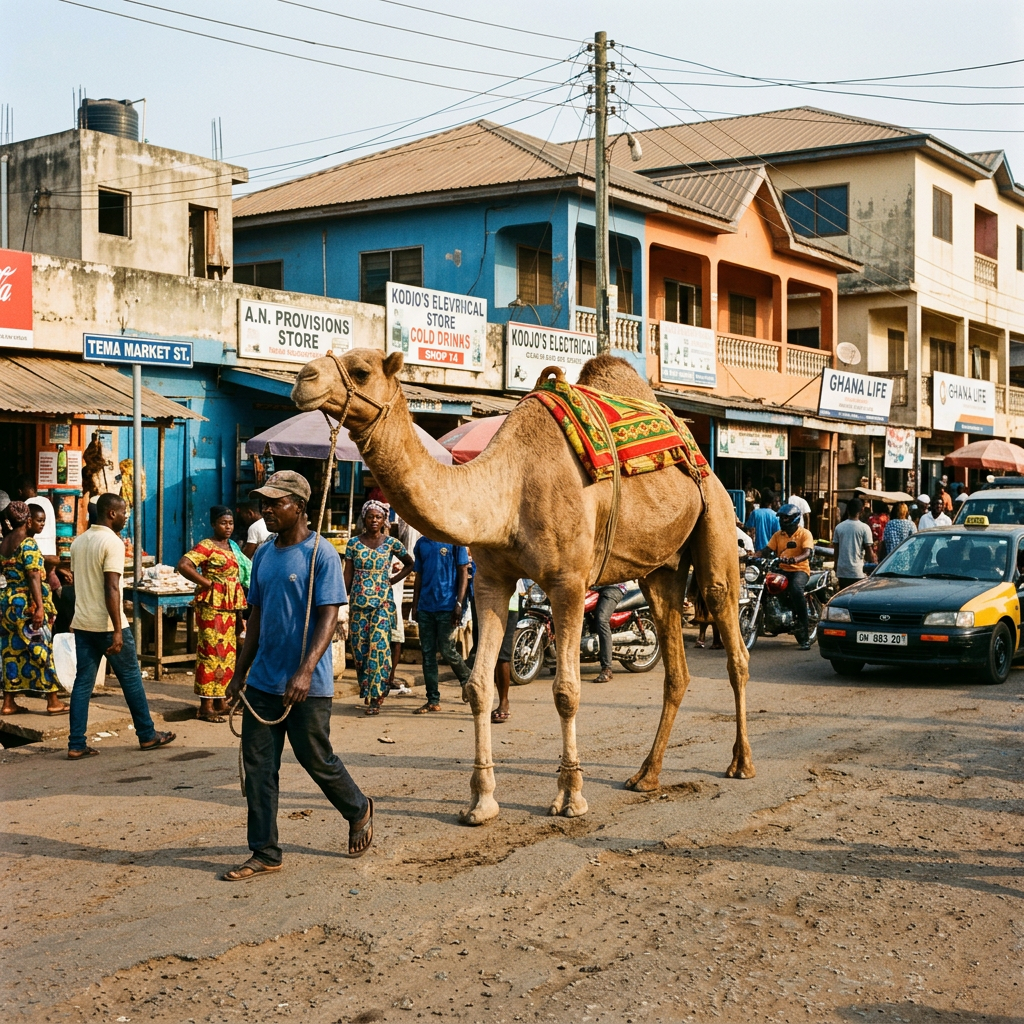
There is something uniquely Ghanaian about seeing a deeply unusual situation, being mildly alarmed, and yet still finding the perfect commentary for it. That is why a video of a man in Tema reacting to camels roaming around Community 12 feels so instantly memorable. (https://vt.tiktok.com/ZSHKwpTuH/).
The humour is effortless. The disbelief is genuine. The concern is real. And yet somehow, the whole thing becomes comedy. A man is essentially saying: what kind of country is this, and why are camels moving about freely like they own the place? It is funny, yes, but it is also strangely revealing.
Because let us be honest: camels in Tema are not normal.
Camels are animals associated with very particular environments. They are not random wandering livestock like goats in a roadside gutter or sheep crossing a dusty lane. Camels are built for dry, arid, desert-like climates. Their bodies are adapted for long periods without water, for extreme heat, for sandy terrain, and for survival in places where many other animals would struggle. Their wide feet help them move across loose sand. Their bodies conserve water in remarkable ways. Their long lashes and closable nostrils help protect them from sandstorms. Everything about a camel suggests a creature shaped by harsh, open landscapes, not by the busy urban sprawl of a coastal industrial city in southern Ghana.
Tema, for all its heat and bustle, is not that environment. As much as R2Bees and Sarkodie try to make Tema look and sound like a hustler’s paradise, it is NOT the Sahara. It is not the Sahel. It is not some vast, empty caravan route where camels naturally blend into the scenery. Tema is a city of estates, the harbour, traffic, trotro stops, shops, container trucks that drive through roundabouts, underground rappers, their own court system. Even though the Fokn Bois rightly stated the communities all dey look the same, going around in squares, to suddenly see camels there, especially on the loose and apparently not under control, is not simply random. It is a red flag.
The comedy of the moment should not completely hide the fact that something is off.
Camels of that size and temperament are not meant to be casually roaming through residential areas. A loose camel is not just an exotic inconvenience. It can create real danger. It can frighten residents (like it did to our chairman), disrupt traffic, cause accidents, injure people, or itself become injured in an environment unsuited to it. The very idea that such an animal could be moving around Community 12 without obvious restraint raises immediate questions. Who brought them there? For what purpose? Why were they not properly secured? Who is responsible if something goes wrong? Why are residents the ones discovering the problem in real time, through shock and commentary, instead of through proper control?
That is what makes the scene both hilarious and unsettling. It is absurd on the surface, but beneath the absurdity is a familiar Ghanaian problem: things are often not under control until they have already become everybody’s business.
And perhaps that is why the video resonates so strongly. It is not just about camels. It is about a pattern we know too well. It is about living in a society where oddity and disorder can break into ordinary life at any moment. Today it is camels in Community 12. Tomorrow it is a fallen container, a burst pipe, a power cut, a flooded street, a stalled truck blocking an entire road, or some official confusion nobody can fully explain. So much of Ghanaian life involves negotiating things that should not be happening in the first place.
Yet somehow, we laugh.
We laugh not because the situation is good, but because the alternative may be frustration, despair, or complete mental exhaustion. We laugh because if we pause too long to fully process the disorder around us, we might genuinely lose our peace of mind. Humour, in that sense, is not superficial. It is survival. It is emotional self-defence. It is how many ordinary Ghanaians create breathing room between themselves and the pressure of daily life.
This is the Ghanaian plight in miniature. We live with endless irregularities. Systems fail, people improvise, responsibility is blurry, and the public is often left to react rather than be protected. But in the middle of all that, somebody will still find the perfect line, the perfect expression, the perfect mix of alarm and comedy. Somebody will narrate the madness in a way that makes everybody laugh. And once people laugh, the burden becomes a little lighter, even if only for a moment.
That is why videos like the one from Tema spread so quickly. They are funny, but they also feel true. They capture the strange social genius of Ghanaians: our ability to turn confusion into commentary, inconvenience into shared humour, and collective frustration into a moment of connection. We make stories out of disorder because stories are easier to carry than stress. We joke because jokes travel faster than complaints. We laugh because laughter is sometimes the only affordable therapy in a country where the pressure never really lets up.
Still, the laughter should not distract us entirely from the warning hidden inside the joke. Camels should not be roaming freely in Tema. That is not quirky; it is a sign of negligence somewhere. It tells us, once again, that too many things in our public life are left to chance until spectacle forces attention. The fact that people are amused does not mean the situation is acceptable. It only means they are coping the way Ghanaians often do: by turning shock into humour before the stress can settle in.
In the end, the camels in Community 12 are more than just a funny sighting. They are a symbol of the strange, exhausting unpredictability of everyday life in Ghana. They remind us of how often the bizarre enters the ordinary, how often disorder parades itself in broad daylight, and how instinctively Ghanaians respond with wit. We laugh through chaos not because we are blind to the seriousness of things, but because we are deeply familiar with it.
And sometimes, truly, if we do not laugh, we go mad.
 Kwabena's Musings